

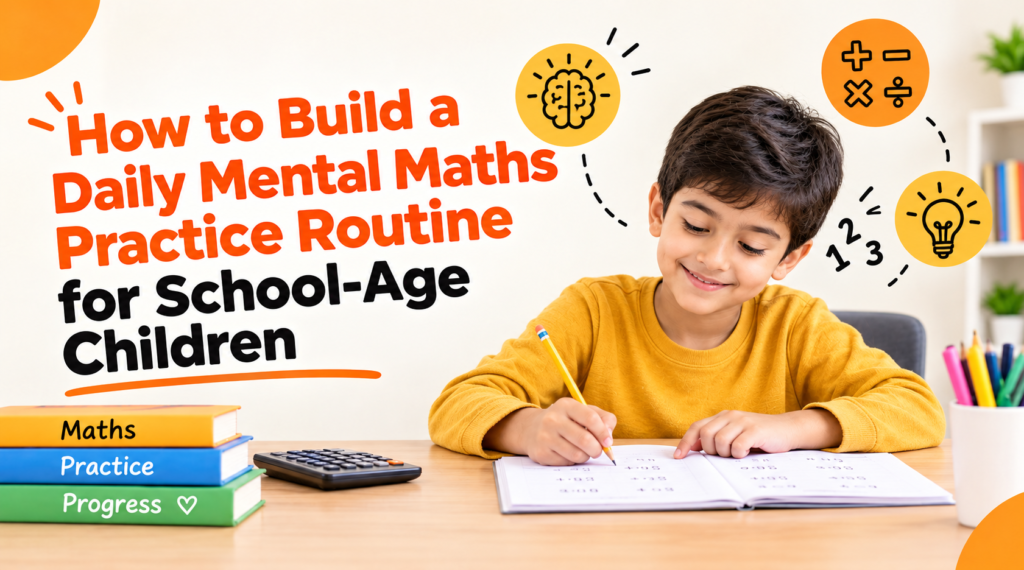
Mental maths practice helps children solve calculations quickly without depending on calculators or written methods. It improves concentration, memory, logical thinking, and problem-solving skills. However, children need regular practice to develop these abilities. A simple daily routine can make mental maths enjoyable and help school-age children become more confident with numbers.
Parents and teachers can introduce small activities into a child’s everyday schedule to make maths learning easier, more engaging, and less stressful.
Start With Short Daily Practice Sessions
Children do not need to spend hours practising mental maths. Start with 10–15 minutes daily and gradually increase the duration according to their age and ability.
You can divide the session into three parts:
- 5 minutes: Revise previously learned calculations.
- 5 minutes: Practise new questions or number patterns.
- 5 minutes: Play a maths game or solve a fun challenge.
A short and consistent routine helps children develop better learning habits without feeling overwhelmed.
Use Abacus Techniques to Improve Number Skills
The abacus is a useful learning tool that helps children understand numbers, addition, subtraction, multiplication, and division. With regular practice, children learn to visualise abacus beads mentally and perform calculations more confidently.
Parents looking for structured learning opportunities can consider Online Abacus Classes, where children can practise number operations with guidance from instructors. These classes can make learning accessible from home while helping children follow a consistent schedule.
Encourage children to practise a few abacus questions every day. Begin with simple calculations and introduce more challenging exercises as their skills improve.
Include Fun Mental Maths Activities
Practice becomes more effective when children enjoy the learning process. Instead of relying only on worksheets, introduce simple games and everyday activities.
Here are some ideas:
- Ask children to calculate the total cost of items while shopping.
- Practise addition and subtraction using toys or household objects.
- Play number games during travel.
- Ask quick questions such as 25 + 15 or 60 − 20.
- Encourage children to find different ways to reach the same number.
These activities connect maths with real-life situations and help children understand how numbers work in everyday life.
Introduce Vedic Maths and Number Tricks
Once children understand basic calculations, parents can introduce simple techniques from Vedic Maths Classes to make mental calculations more interesting.
Age-appropriate number patterns and calculation tricks can help children recognise relationships between numbers and develop flexible problem-solving skills. However, children should first understand basic mathematical concepts before moving to advanced techniques.
Keep the activities suitable for their learning level and encourage them to explain how they reached an answer rather than focusing only on speed.
Set Weekly Goals and Track Progress
A daily routine works best when children can see their improvement. Set small, achievable goals, such as completing ten questions accurately or learning a new calculation method.
Maintain a simple progress chart to record practice sessions, completed activities, and skills learned. Celebrate effort, consistency, and improvement rather than comparing children with others.
Accuracy should come before speed. As children become more comfortable with calculations, their speed will often improve naturally.
Choose the Right Learning Support
Some children learn better through individual practice, while others benefit from structured classes and instructor guidance. Parents can explore suitable learning programmes based on their child’s needs.
For example, families searching for Abacus classes in Canada or Abacus Classes in Delhi can look for programmes that offer regular practice, age-appropriate lessons, and progress tracking.
Educators interested in teaching these skills can also explore abacus teacher training to develop their teaching knowledge and learn effective ways to guide children through abacus-based learning activities.
For aspiring education entrepreneurs, an abacus franchise may provide an opportunity to establish a structured learning centre and introduce abacus education to more children.
Conclusion
Building a daily mental maths routine does not have to be complicated. Just 10–15 minutes of consistent practice, fun number games, abacus activities, and simple calculation challenges can help children strengthen their mathematical skills over time.
The key is to make learning enjoyable, set realistic goals, and encourage children to keep trying. With patience and regular support from parents and teachers, children can develop greater confidence, concentration, and a positive attitude towards mathematics.